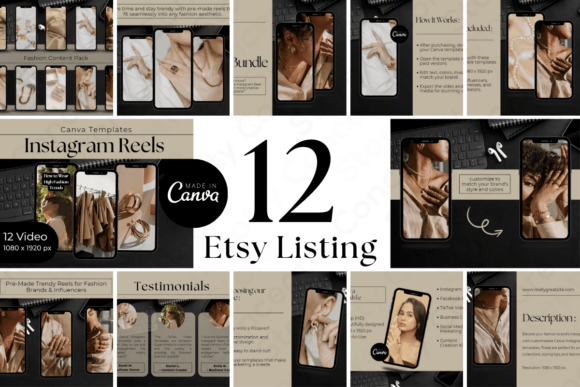
Rethinking Etsy Product Presentation With the 12-Page Etsy Listing Canva Template V.7
Most Etsy sellers understand that visuals drive purchasing decisions. Yet many still rely on a handful of product photos and a hastily written description, hoping the algorithm will do the rest. The reality is more nuanced. Buyers need to trust what they cannot touch, and trust is built through deliberate visual storytelling, not accidental presentation. The 12-Page Etsy Listing Canva Template V.7 offers a structured way to approach that storytelling, giving sellers a framework that balances aesthetic consistency with practical information delivery.
This is not simply a set of pretty layouts. The template functions as a strategic communication tool for anyone selling physical products, digital downloads, or creative services on Etsy. Its landscape orientation, sized at 3000 pixels wide by 2250 pixels tall, aligns well with the platform’s image display requirements while giving you enough canvas area to layer multiple elements without crowding. That technical detail matters because cluttered images often repel the very buyers you are trying to attract.
Why Visual Structure Shapes Buyer Confidence
When a potential customer lands on your listing, they make rapid judgments about your professionalism, reliability, and product quality. These judgments are rarely conscious. They are shaped by how easily the eye moves across your images, whether key information is findable, and if the visual tone feels cohesive. A template like the 12-Page Etsy Listing Canva Template V.7 addresses this by offering 12 distinct pages, each with a different layout purpose, so you are not forcing a single design to do too much work.
Consider the mental sequence of a buyer. They see your thumbnail in search results and click. The first image either confirms or contradicts their expectation. From there, they swipe or scroll through the remaining images, looking for reassurance. They want to see the product in use, understand its dimensions, read what others have experienced, and grasp why your offering is worth the price. A disjointed image gallery disrupts that sequence and introduces doubt. A thoughtfully planned gallery, assembled with a consistent template system, reduces friction and keeps attention where it belongs—on the product.
Planning a Listing Strategy Before Customizing Any Template
Templates work best when you know what you need to communicate before you start moving elements around. Opening Canva and dropping in images without a plan often leads to generic results that fail to differentiate your shop. Before touching the 12-Page Etsy Listing Canva Template V.7, map out your listing goals.
Start by answering three questions. What are the top three hesitations a buyer might have about your product? Which features need visual proof rather than just text? And what emotional outcome does your buyer actually want? For a handmade ceramic mug, the hesitation might be durability, the feature needing proof could be the glaze finish in different lighting, and the emotional outcome might be a calm morning ritual. Your template pages should then be assigned to address these points in sequence.
This planning step prevents what often happens when sellers adopt templates without direction: every page looks polished but none of them answer the buyer’s unspoken questions. The result is a listing that impresses visually but underperforms commercially.
Mapping the 12 Pages to Buyer Decision Stages
With 12 pages available, you have enough room to guide a buyer from initial curiosity through to confident purchase. A useful approach is to think of the pages in three clusters: attention, evaluation, and reassurance.
The attention cluster, typically the first two to three images, needs to stop the scroll. This is where you use your strongest product photograph, perhaps a lifestyle shot that shows the item in a context your target buyer recognizes. The 12-Page Etsy Listing Canva Template V.7 includes layouts that accommodate hero images with subtle text overlays for your unique value proposition, without the text overpowering the visual.
The evaluation cluster occupies the middle pages. Here you can present close-ups that reveal texture and quality, infographic-style pages that break down dimensions or materials, and comparison layouts if your product comes in variants. Templates that offer infographic elements are particularly valuable because they transform dry specifications into something scannable. A buyer who can instantly understand size, weight, or compatibility is less likely to abandon the listing to search for details elsewhere.
The reassurance cluster closes the loop. This is where testimonials, review highlights, and trust signals appear. A dedicated page for a curated customer quote, paired with a photo of the product in that customer’s environment, carries more weight than a star rating alone. When the 12-Page Etsy Listing Canva Template V.7 is used to sequence these clusters intentionally, the listing feels like a conversation rather than a data dump.
Adapting the Template Across Different Product Categories
One of the more practical aspects of this template is its category-agnostic design. Whether you sell digital sewing patterns, printable wall art, handmade jewelry, or vintage clothing, the neutral modern aesthetic does not compete with your product’s identity. This matters because overly stylized templates can clash with your brand or limit your ability to pivot product lines later.
For digital products, the template pages can showcase mockups of the download in use, step-by-step instructions for accessing files, and screenshots of the contents. For physical goods, lifestyle imagery and detail shots take priority. The landscape orientation also lends itself well to side-by-side comparisons, which can be useful for sellers offering custom variations or bundled sets.
What you avoid by using a cohesive 12-page system is the patchwork look that comes from creating listing images over multiple sessions with different tools or design decisions. Brand consistency across listings signals to buyers that you operate with intention, and that signal can influence repeat purchases and shop follow rates.
Using the Template Beyond Etsy Listings
Although the template is designed for Etsy product pages, its utility extends further. Many sellers need marketing assets for Instagram, Facebook, Pinterest, and email campaigns. Because the 12-Page Etsy Listing Canva Template V.7 is built in Canva, you can resize and repurpose pages for social media posts, Reels covers, story backgrounds, and promotional graphics without starting from scratch.
This repurposing capability solves a common bottleneck for small business owners. Creating separate assets for each channel often leads to visual inconsistency or, worse, neglected channels because the design work feels overwhelming. By adapting listing pages for social content, you maintain visual coherence while reducing the time spent on marketing production. A testimonial page from your listing can become a standalone Instagram post. A feature infographic can be repurposed for a Pinterest pin with minimal adjustment.
Fashion brands, in particular, can benefit from the stylish layouts suited for trendy Reels and platform-ready content. The neutral foundation of the template lets product textures, colors, and styling choices remain the focal point, which is essential when your brand identity is tied closely to visual aesthetics.
Avoiding Common Pitfalls When Using Templates
Templates reduce friction, but they do not replace judgment. One risk is over-relying on the structure and forgetting to tailor each page to the specific product and audience. A template page designed for testimonials works only if the testimonial you include is relevant, specific, and believable. If you force placeholder content or generic praise into a beautiful layout, the disconnect will register with perceptive buyers.
Another risk is information overload. Having 12 pages available does not mean you must use all of them for every product. Some listings may need only eight carefully crafted images. Others may genuinely need all 12. The decision should be driven by product complexity and buyer information needs, not by the template’s capacity.
Additionally, pay attention to how template elements interact with Etsy’s mobile display. Many buyers browse on phones, and text that is readable on a desktop preview may become illegible when scaled down. Test your completed pages on a mobile device before publishing. The 12-Page Etsy Listing Canva Template V.7, at 3000 by 2250 pixels, gives you high resolution to work with, but legibility still depends on font sizing and contrast choices made during customization.
Building a Long-Term Brand Asset From Repeatable Templates
When you use the same template system across multiple listings, you are not just saving time on each individual product page. You are building a recognizable visual language that buyers associate with your shop. Over time, returning customers will recognize your listing style before they even see your shop name. That recognition reduces the cognitive effort required to trust a new product from you.
This is especially valuable for sellers who plan to scale their product catalog. Instead of reinventing the presentation wheel for each addition, you can focus creative energy on product development, sourcing, and customer service. The 12-Page Etsy Listing Canva Template V.7 becomes part of your operational infrastructure, similar to inventory management or shipping workflows.
For sellers who also offer services such as custom designs, coaching, or freelance work, the template can be adapted into a portfolio-style presentation that outlines process, deliverables, and past client outcomes. The neutral design language makes it suitable for professional services without appearing overly corporate.
Making Thoughtful Customization Choices
Customization is where strategic thinking meets execution. The template’s design elements are meant to be edited, but thoughtful editing means preserving the relationships between elements that make the layout work. If you replace a sans-serif font with an elaborate script, ensure readability holds up. If you swap the color palette, test whether text remains accessible against background images. Small adjustments can compound into significant usability problems if applied without consideration.
A practical approach is to customize once for your brand—setting your fonts, color accents, and logo placement—and then save that version as your master template. For each new product listing, duplicate the master and swap in product-specific content. This workflow maintains consistency while keeping the per-listing effort manageable.
Also consider the narrative flow from page to page. A buyer should be able to swipe through your images and feel like they are being guided, not thrown between unrelated information. Transition pages that summarize what has been shown and hint at what comes next can improve engagement, especially for higher-priced items where the decision process is more deliberate.
Integrating the Template Into a Larger Marketing System
The 12-Page Etsy Listing Canva Template V.7 works most effectively when it is part of a broader communication strategy. Your listing images should align with the tone of your product descriptions, the style of your shop banner, and the content you publish on social media. This alignment is not about being identical everywhere; it is about creating a coherent impression that reinforces your brand positioning.
For example, if your brand emphasizes sustainability, the template can be customized to include pages that highlight materials sourcing, production methods, and packaging choices. These details, presented visually, differentiate your shop from competitors who only mention sustainability in text descriptions. The template gives you the structure; your brand strategy gives it meaning.
Sellers who treat templates as shortcuts may miss this integration opportunity. Those who treat them as communication frameworks are more likely to produce listings that not only look professional but also convert browsers into buyers at a higher rate.
Evaluating Whether This Template Fits Your Current Needs
Before purchasing any template, assess your current listing performance and identify where the gaps exist. Are buyers frequently asking questions that your images should already answer? Do your listings suffer from high bounce rates despite strong search rankings? Is your product photography good but your image design inconsistent? If any of these scenarios apply, a structured template system can address the underlying issues.
The 12-Page Etsy Listing Canva Template V.7 is particularly suitable for sellers who want to move beyond the limitations of Etsy’s default listing format without hiring a designer for each product. It suits those who value a modern, minimalist aesthetic and need layouts flexible enough to accommodate diverse product types. It may be less suitable for sellers whose brand identity relies on maximalist, heavily illustrated, or highly niche visual styles that a neutral template cannot easily accommodate.
Ultimately, the template is a tool, not a solution. Its value depends on how thoughtfully you align it with your product story, buyer psychology, and long-term brand goals. When used with clear intentions, it can elevate the professionalism of your Etsy presence and create a more satisfying experience for every visitor who lands on your listings.