Why Isometric Construction Illustrations Are Reshaping Visual Communication in the Building Industry
Visual storytelling has always been at the heart of how architects, engineers, and construction professionals convey complex ideas. In recent years, a quiet but significant shift has taken hold across design studios, marketing departments, and digital product teams: the widespread adoption of isometric illustration. Among the most sought-after assets in this space is the Builder and Construction Tools Isometric illustration set — a carefully crafted collection that speaks directly to the evolving needs of modern creators, marketers, and technical communicators. But what makes these types of illustrations resonate so strongly right now? The answer lies at the intersection of changing workflows, heightened visual expectations, and a growing demand for assets that are both beautiful and infinitely adaptable.
Understanding Isometric Illustration in the Construction and Engineering Context
Isometric projection is a method of visually representing three-dimensional objects in two dimensions. Unlike perspective drawing, where objects appear smaller as they recede into the distance, isometric illustration maintains consistent scale along all three axes. This creates a clean, diagrammatic look that feels both technical and approachable — a perfect marriage of precision and warmth. For the construction and engineering sectors, this visual language has become indispensable. A Builder and Construction Tools Isometric illustration set captures the essence of hammers, wrenches, hard hats, blueprints, scaffolding, measuring tapes, power drills, and safety gear in a way that feels contemporary, organized, and instantly readable.
What separates a high-quality isometric toolkit illustration from a generic icon set is the level of perfection in details and consistency. When every tool shares the same lighting direction, the same stroke weight, the same color harmony, and the same spatial logic, the result is a cohesive visual system rather than a loose collection of drawings. This coherence is what allows designers to combine elements freely, confident that the final composition will look intentional and polished.
The Broader Industry Shift Toward Modular Visual Assets
The construction industry is undergoing a digital renaissance. Building information modeling, augmented reality walkthroughs, drone surveying, and cloud-based project management platforms have all raised the bar for how information is presented. In parallel, the marketing of construction services, tools, and technologies has become more sophisticated. Gone are the days when a grainy stock photo of a construction site sufficed for a landing page or a trade show banner. Today’s audiences — whether they are enterprise clients, homeowners, or municipal planners — expect clarity, professionalism, and a touch of creativity. This is precisely where the Builder and Construction Tools Isometric illustration format shines.
Marketers and content creators are increasingly turning to editable vector illustrations because they offer something that static photography cannot: infinite flexibility without sacrificing visual impact. Need to change a tool’s color to match your brand palette? With a well-organized AI or EPS file, that adjustment takes seconds. Want to isolate a single hard hat icon for a mobile app button? The file is ready. Need to combine a crane, a cement mixer, and a set of blueprints into a hero graphic for a website? The layers are waiting for you. This modularity reflects a broader trend in creative workflows — one where speed, customization, and brand consistency are non-negotiable.
Why People Are Paying Attention to Isometric Construction Illustrations Right Now
Several converging factors explain the growing attention around isometric construction imagery. First, the remote and hybrid work revolution has accelerated the need for clear, self-explanatory visuals. When teams are distributed across cities or continents, a well-designed isometric diagram can communicate a construction sequence, a safety protocol, or a tool specification more effectively than paragraphs of text. Second, the rise of no-code and low-code platforms has empowered non-designers to build sophisticated websites, apps, and presentations — fueling demand for ready-to-use, professional-grade illustration packs. Third, social media algorithms continue to favor visually distinctive content. An isometric illustration of a construction tool set, rendered in crisp vector style with subtle shadows and vibrant accents, stops the scroll in ways that standard photography often does not.
There is also a cultural dimension at play. The maker movement, the resurgence of interest in skilled trades, and a broader appreciation for craftsmanship have all contributed to an aesthetic environment where tools themselves become icons. A beautifully illustrated circular saw or a meticulously detailed spirit level carries symbolic weight: it represents competence, reliability, and hands-on expertise. Creators and brands are tapping into this visual language to build trust and convey authority.
Practical Applications Across Print, Web, Symbols, Apps, and Infographics
The versatility of a well-constructed isometric illustration set cannot be overstated. When a collection is described as suitable for print, web, symbols, apps, and infographics, that is not marketing fluff — it is a reflection of genuine technical capability. Let’s break down what that means in real-world terms.
For print, vector-based AI and EPS files ensure that illustrations can be scaled to billboard size or shrunk to fit a business card without any loss of quality. This is essential for trade show graphics, safety manuals, product catalogs, and construction site signage. For web, the same illustrations can be exported as optimized SVGs or PNGs, maintaining crisp edges on high-resolution displays. The JPG format included in the collection provides a convenient raster option for quick placement in blog posts, email newsletters, or social media graphics.
When it comes to symbols and apps, the consistent visual language and organized layer structure become critical. App designers can extract individual tools to use as navigation icons, status indicators, or feature highlights. Because the files are neatly organized with a clear file and layer structure, locating a specific element — say, a welding mask or a jackhammer — takes moments rather than minutes. This efficiency compounds over the course of a project, saving hours of frustration and enabling faster iteration.
Infographics represent perhaps the most powerful use case. Construction companies, engineering consultancies, and tool manufacturers frequently need to explain complex processes: project timelines, safety statistics, equipment maintenance schedules, sustainability metrics. Isometric illustrations provide a visual anchor that makes data more digestible. A timeline punctuated by isometric tools feels dynamic and grounded. A percentage statistic paired with an isometric hard hat feels human and relevant. The ability to edit, change colors, and modify icons easily according to specific needs means that every infographic can be tailored to a unique narrative without starting from scratch.
Three Variations and the Value of Choice
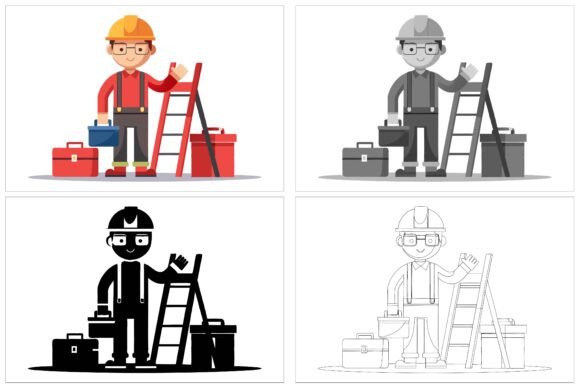
A standout feature of the Builder and Construction Tools Isometric collection is the inclusion of three variations. Variation is not merely a quantity multiplier — it is a strategic asset. Different projects demand different visual tones. One variation might feature a bolder color palette suited for a construction startup’s landing page. Another might offer a more subdued, technical look ideal for an engineering report or a government proposal. The third could provide an outline or flat-design treatment that integrates seamlessly into an existing design system. Having access to three distinct stylistic interpretations within a single purchase empowers creators to maintain visual consistency across multiple platforms while adapting to context-sensitive requirements.
This tri-variation approach also speaks to the reality of modern brand ecosystems. A company might use one variation on its website, another in its mobile app, and the third in printed training materials — all while preserving a recognizable visual DNA. The underlying file structure remains consistent, so teams can switch between variations without relearning the organization of the assets.
Designed for Mac and Windows Users: Cross-Platform Compatibility as a Necessity
Creative teams are rarely homogeneous in their choice of operating systems. A graphic designer might work on a Mac, while an engineer preparing a presentation might be on Windows. A marketing manager reviewing assets might use a Windows laptop, while an external agency partner runs macOS. The fact that this illustration set is designed for Mac and Windows users reflects a practical understanding of how collaborative workflows actually operate. AI (Adobe Illustrator) and EPS formats are native to both environments, and JPG files are universally accessible. There is no conversion hassle, no font substitution anxiety, and no unexpected rendering issues that derail a tight deadline.
This cross-platform compatibility extends to the growing number of alternative vector editing applications that have gained traction in recent years — Affinity Designer, CorelDRAW, Inkscape, and even browser-based tools like Figma often support AI and EPS imports. Purchasing assets that adhere to widely supported standards future-proofs the investment and reduces dependency on a single software ecosystem.
Perfection in Details and Consistency: The Invisible Competitive Advantage
One of the most undervalued qualities in digital illustration assets is perfection in details and consistency. When a designer purchases an illustration pack, they are not just buying shapes — they are buying time. Every minute spent fixing misaligned anchor points, correcting inconsistent lighting, or cleaning up poorly named layers is a minute stolen from creative exploration. A meticulously crafted isometric construction tool set respects the user’s time by arriving in a state of near-readiness.
Consistency also has a direct impact on perceived professionalism. When a safety poster, a website banner, and a mobile app icon all share the same isometric perspective and stylistic treatment, the cumulative effect is one of brand cohesion and attention to detail. Audiences may not consciously notice the consistency, but they will certainly notice its absence. Sloppy illustration work undermines credibility, especially in fields like construction and engineering where precision is a core value.
The Growing Intersection of Construction, Technology, and Consumer Expectations
We are living through a period where the boundaries between industries are blurring. Construction technology startups are raising significant venture capital, smart home platforms are making building tools part of the consumer experience, and sustainability reporting is pushing engineering firms to communicate their environmental impact visually. In this landscape, the humble illustration has become a strategic communication tool. A Builder and Construction Tools Isometric collection is not just a set of pretty pictures — it is a visual vocabulary that helps organizations articulate their role in a rapidly changing world.
Consider a prop-tech company that builds software for construction site management. Their marketing website needs to convey technical sophistication while remaining inviting to non-technical decision-makers. Isometric tool illustrations bridge that gap. They signal industry knowledge without intimidating the visitor. The same logic applies to vocational training platforms, DIY tutorial websites, tool review blogs, and even municipal planning portals. In each case, clear, editable, professional illustrations lower the barrier to understanding and elevate the overall user experience.
Why the Time to Invest in Quality Visual Assets Is Now
The digital asset marketplace has grown exponentially, but quality remains uneven. Many illustration packs are rushed, poorly organized, or stylistically inconsistent. Finding a collection that combines neat organization, file and layer structure, perfection in details, and genuine versatility across print, web, symbols, apps, and infographics is rarer than it should be. When such a collection also includes three distinct variations and seamless compatibility with both Mac and Windows environments, it represents a significant value proposition for any professional who values their time and their craft.
The construction and engineering sectors have always understood the importance of the right tool for the job. In the digital realm, the right illustration set is that tool. It accelerates workflows, sharpens communication, and quietly communicates a commitment to quality that audiences recognize and respect. Whether you are building a brand, designing an app, creating educational content, or preparing a client presentation, the ability to edit, change colors, and modify icons easily according to your needs transforms a static purchase into a living resource that grows with your projects.
So what are you waiting for? The assets are ready, the files are organized, the variations are versatile, and the creative possibilities are waiting to be unlocked. Buy now and start using this awesome illustration to bring clarity, professionalism, and visual impact to your next project. Your audience — and your workflow — will thank you.