The Art and Utility of Cristmas Tree Illustrations in Modern Digital Design
Visual storytelling has always held a central place in human communication, and few symbols carry the warmth, nostalgia, and universal recognition of the Cristmas Tree. Whether you are a graphic designer preparing seasonal campaigns, a business owner refreshing your brand's holiday presence, or an educator crafting engaging classroom materials, the quality of your visual assets directly influences how your message resonates. In the realm of digital illustration, the shift toward vector-based resources has transformed how creators approach festive design projects, offering unprecedented flexibility without sacrificing detail or consistency.
What many designers discover over time is that not all illustration sets are built to the same standard. The difference between a frustrating editing experience and a seamless creative workflow often comes down to how thoughtfully the files are prepared. This is where well-structured AI EPS illustration collections featuring a Cristmas Tree motif become invaluable tools in a creator's arsenal, serving purposes that extend far beyond simple decoration.
Understanding Vector Illustrations and Their Role in Seasonal Design
Vector graphics operate on mathematical principles rather than pixel grids, which means they scale infinitely without degradation. This technical foundation makes formats like AI (Adobe Illustrator) and EPS (Encapsulated PostScript) the preferred choice for professionals who need their work to transition smoothly between a business card and a billboard. When applied to a subject like the Cristmas Tree, vector art captures the intricate details of ornaments, branch textures, and lighting effects in a way that remains crisp at any dimension.
The inclusion of JPG versions alongside editable vector files in a well-rounded illustration set addresses a practical reality: not every team member or project stage requires full editability. Sometimes a high-resolution raster image is exactly what a web developer or social media manager needs for quick implementation. Having access to multiple formats within a single collection reduces the friction that often slows down collaborative creative projects.
Why File Organization Matters More Than You Might Expect
Opening a downloaded illustration set to find a chaotic jumble of unnamed layers and scattered elements is a common frustration that drains productive time. A neatly organized file and layer structure transforms the editing experience from tedious detective work into an intuitive creative process. When every component of a Cristmas Tree illustration is logically grouped and clearly labeled, designers can isolate specific elements for customization without accidentally disturbing other parts of the composition.
This organizational discipline also supports long-term usability. Months or even years after the initial purchase, a designer returning to the same file will quickly orient themselves within the layer hierarchy, making seasonal updates efficient rather than requiring a complete rebuild. For agencies and in-house creative teams that revisit holiday themes annually, this consistency translates directly into cost savings and faster turnaround times.
The Versatility of a Well-Designed Cristmas Tree Illustration Set
Seasonal imagery often carries the risk of being too niche or limited in its applicability, but a thoughtfully crafted Cristmas Tree illustration transcends singular use cases. The same core graphic, with minor modifications to color palette and surrounding elements, can serve print materials, digital interfaces, product packaging, and environmental graphics equally well. This adaptability stems from the foundational quality of the artwork and the editability built into the file structure.
Consider the range of real-world applications where such illustrations prove their worth. A small business owner might incorporate the tree graphic into a holiday email newsletter header, then adapt the same illustration for in-store signage by adjusting the color scheme to match their brand identity. An educator could use the illustration in a winter-themed worksheet while a researcher presenting data about seasonal consumer behavior might integrate a simplified version into an infographic. The common thread is that the base asset remains consistent while its expression shifts to meet diverse needs.
Print Applications and Production Considerations
When preparing artwork for print, the technical requirements become more demanding. Color modes must shift from RGB to CMYK, resolution expectations rise, and bleed areas need attention. Illustrations designed with perfection in details and consistency handle these transitions gracefully because the foundational artwork was built with professional production standards in mind. A Cristmas Tree illustration that looks charming on screen but falls apart under print magnification reveals the shortcuts taken during its creation.
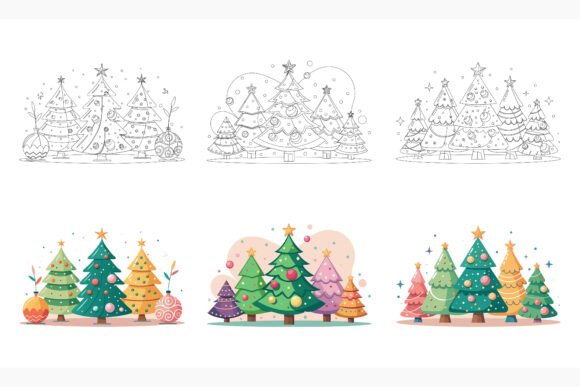
The availability of three variations within a single set addresses the reality that different print contexts demand different visual treatments. A minimalist line-art version might suit elegant stationery, while a richly detailed full-color rendering works beautifully for large-format posters or fabric prints. Having these options ready-made accelerates the design process and ensures visual coherence across a campaign's touchpoints.
Digital and Interactive Media Integration
Web designers and app developers face their own set of challenges when incorporating illustrated elements into digital products. File weight, scalability across device resolutions, and compatibility with various content management systems all influence whether an illustration integrates smoothly or creates technical headaches. EPS and AI files serve as master assets from which optimized web formats can be exported at any required dimension, ensuring that the final delivered image balances visual quality with performance considerations.
For user interface designers, the ability to edit, change colors, and modify icons easily is not merely a convenience but a necessity. A Cristmas Tree icon destined for a navigation menu must harmonize with the existing color system and visual language of the application. Rigid, uneditable graphics force compromises elsewhere in the design, whereas flexible vector assets adapt to established patterns without disrupting the user experience.
Cross-Platform Compatibility and Workflow Integration
The modern creative workplace rarely operates on a single operating system. Design teams commonly include both Mac and Windows users, and collaborative projects pass through multiple hands before reaching completion. An illustration set that functions reliably across platforms eliminates a significant point of friction in the production pipeline. Font rendering differences, color profile management, and file path conventions can all introduce inconsistencies when files are not properly prepared for cross-platform use.
Professional illustration collections address this by adhering to standards that both operating systems recognize and handle predictably. EPS files, in particular, have served as a universal exchange format for decades precisely because they are designed to maintain integrity regardless of the platform opening them. For creative directors managing distributed teams, knowing that every member can access and work with the same high-quality assets without compatibility issues is a substantial operational advantage.
Customization Potential and Creative Freedom
The true measure of an illustration set's value often emerges in how far it can be pushed beyond its original appearance. A Cristmas Tree graphic that arrives as a flat, uneditable image serves exactly one purpose and one aesthetic. The same subject delivered as layered, editable vector artwork becomes a springboard for creative exploration. Designers can recolor ornaments to match brand palettes, restructure branch arrangements for unique compositions, or extract individual elements like stars and baubles for use in entirely different contexts.
This level of control matters particularly for brands and organizations with established visual identities. The ability to infuse seasonal imagery with brand-specific colors and stylistic treatments maintains coherence while still participating in the festive visual language that audiences recognize and respond to. What results is not generic holiday decoration but a distinctive expression that reinforces brand recognition even within a seasonal framework.
- Adjust ornament colors to align with corporate brand guidelines
- Modify the tree silhouette for unique stylistic signatures
- Extract and repurpose individual decorative elements
- Combine elements from different variations for hybrid designs
- Scale specific details independently for emphasis or subtlety
Technical Excellence as a Foundation for Creative Work
Behind every illustration that feels effortless to use lies considerable technical diligence. Perfection in details and consistency does not happen by accident. It reflects deliberate attention to anchor points, curve smoothness, color harmony, and structural logic within the file. When these foundations are solid, designers spend their time on creative decision-making rather than fixing poorly constructed paths or wrestling with inconsistent styling across variations.
For professionals working on tight deadlines, this reliability carries tangible value. The confidence that comes from knowing an illustration set will perform as expected allows creative energy to flow toward composition, messaging, and audience engagement rather than technical troubleshooting. This principle applies whether the end product is a print advertisement, a web banner, a set of symbols for wayfinding, an app interface element, or a data-rich infographic.
Integrating Seasonal Illustrations Into Year-Round Design Systems
One of the more sophisticated approaches to using themed illustration sets involves thinking beyond their obvious seasonal application. The visual language of a Cristmas Tree, when abstracted thoughtfully, can inform design elements that function throughout the year. Pine branch textures might inspire background patterns, the geometric structure of ornament arrangements could influence icon grid systems, and the color relationships within the illustration might seed broader palette explorations.
This extended utility mindset transforms what could be a single-use purchase into a lasting design resource. Educators building visual libraries, content creators maintaining consistent channel aesthetics, and business owners developing brand asset collections all benefit from resources that continue generating value beyond their immediate and obvious application.
The landscape of digital illustration continues to evolve, with expectations around quality, flexibility, and usability rising steadily across all user groups. Whether you are a seasoned designer evaluating assets for a major campaign or a hobbyist bringing a personal project to life, the underlying principles remain consistent. Thoughtfully constructed vector illustrations, particularly those centered on universally recognized subjects like the Cristmas Tree, represent not just a product but a foundation upon which countless creative outcomes can be built. The investment in quality, organization, and editability pays dividends across every project that draws upon these resources, making the choice of illustration set a decision that ripples through every subsequent creative endeavor.